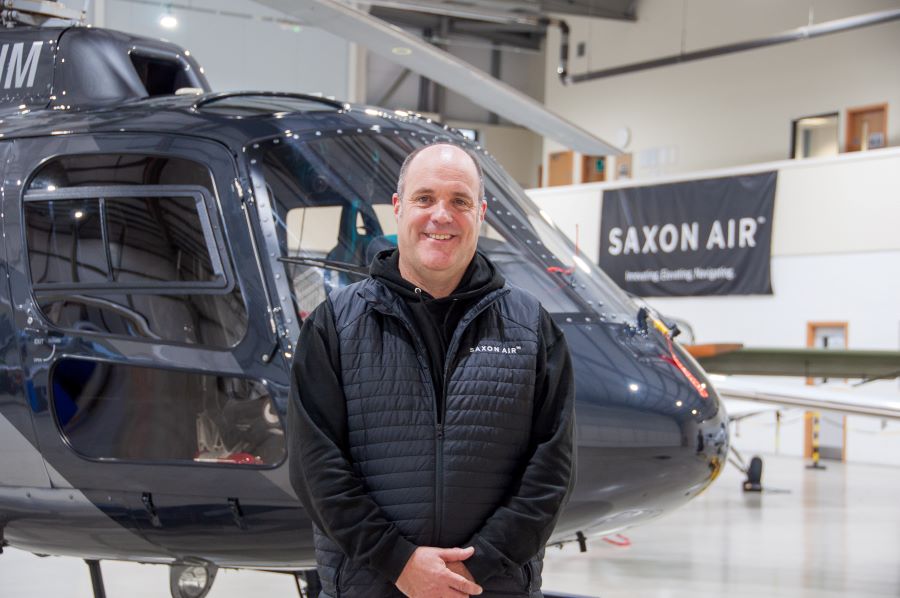

Innovating l Elevating l Navigating: Alex Durand, Saxon Air
There’s a fundamentally different perspective involved, depending on which view is taken.
The former puts the organisation in control, cherry-picking what it perceives as the best skills for a role; the latter positions the organisation more as a servant of its community, removing barriers for entry to employment and looking for latent talent, throwing the net as wide as possible.
What does this mean in practical terms? There are specialist roles that do require particular skills and experience. However, if we’re not careful we can take this too far and drift away from the community that supports us, maybe missing talent and perspectives that would enrich us. We also allow ourselves to be defined by these somewhat arbitrary frameworks we’ve set for ourselves, and in doing so, who do we inadvertently exclude?
Let’s take my workplace, Saxon Air, as a case study. We have positions that require years (and £££s!) of qualifications and experience. We also have roles that require great situational awareness, mental agility, resilience, and commitment. You can probably guess which of these is a pilot and which is a ground marshaller, but many of their attributes are shared and, most importantly, both are integral to the success of our business. Indeed, what does ability actually mean here? Physical and mental skills or an ability to access the considerable funds required to become a pilot?
There’s also another factor. The word ‘ability’ can easily be weaponised, and when fully loaded causes enormous damage. Adding the prefix ‘dis/dys’ implies a diminishing of ability and starts from a position that implies there’s an objective ‘normal’. Dis-ability, dys-lexia, dys-praxia etc – all around us every day but with this prefix there’s a negative connotation. How about looking for what someone is suited to do, not what doesn’t match their talents?
Identify and nurture
Aviation is probably one of the more role-defined industry sectors and here we go back to the first point – in a highly systemised, safety-critical environment, it’s tempting to rely on funnelling applicants according to well-established backgrounds, and seemingly less risky to do so.
But what are we missing? What ability best suits cleaning an aircraft, procedural compliance, safety critical task repetition, manual production, memory for a face on security patrols, etc? I can guarantee I wouldn’t even get an interview, but they’re all key skills and capabilities from which we would benefit. Positively nurturing roles that require these attributes would make us a better and more rounded business, as we’d have individuals contributing to our workplace culture that, currently, aren’t nearly as present as they should be.
What do we do about this? Look for those who may be in the margins, those feeling unqualified or unempowered, excluded from standard educational outcomes, or just recovering from the many setbacks that life throws at us. The widest interpretation of inclusivity can throw a spotlight into the shadows we’ve inadvertently created.

GET IN TOUCH
Alex Durand is CEO at Saxon Air
T: 01603 518217
E: ad@saxonair.com
Or visit www.saxonair.com